
CASE STUDYNavigating without a GNSS (Global Navigation Satellite System)
Howcan you navigate your way through tunnels when you can’t get a GNSS signal underground?
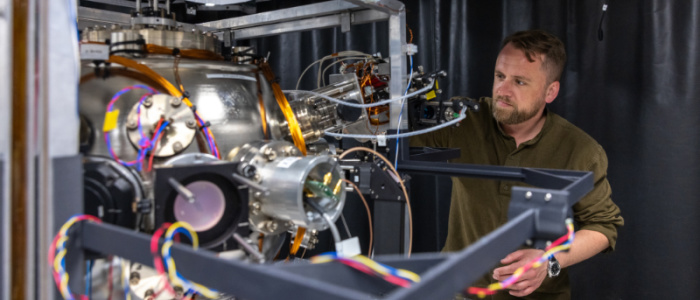
QEPNT researchers are developing sensor systems that use clouds of atoms cooled to just above absolute zero to navigate without requiring GNSS. Through a system of lasers, the atoms are split into different states, and as they act as both particles and waves, create an interference pattern when they recombine. Measuring these patterns allow us to detect changes in movement without requiring external signals.
This sensor technology could enable reliable navigation in tunnels for trains and be used to help track ships out at sea.
Currently, the UK relies on GNSS (satellite-based navigation) for determining position and navigation, and it underpins vital areas of the Uk’s economy, infrastructure and national security. However, GNSS is vulnerable to interference and attacks, and the signals can be affected by bad weather, tall buildings and poor coverage underground or underwater.
Researchers are developing quantum-enhanced sensors that can be deployed in rail and maritime environments, with a view to developing future long-range quantum navigation systems that can operate in satellite denied environments.
Researchers are using quantum techniques to develop devices that can accurately pinpoint their location, no matter where they are located, and creating a new generation of underground and underwater sensors.
The devices don’t require external signals such as GPS, so you don’t have to worry signals being jammed or lost or blocked by bad weather or tall buildings. This improves accuracy of positioning.
At present, trains are detected and monitored using fixed trackside infrastructure which can be expensive to install and can be vulnerable to bad weather such as storm damage.
Research is developing quantum navigation that will provide a more reliable, low cost and resilient train detection system.
Our next generation sensors have applications in:
- Navigation – aircraft, underwater vehicles, spacecraft and connected and autonomous vehicles (CAVs)
- Telecommunications
- Energy
RESEARCH
Researchers worldwide are driving progress in this area with UK universities and industry playing an important role through the EPSRC-funded QEPNT and QUSIT Hubs.