CASE STUDYDefence
HOWIS QUANTUM COMPUTING STRENGTHENING DEFENCE CAPABILITIES?
Quantum technologies are an emerging family of technologies that exploit the behaviour of matter and light at the atomic scale to deliver capabilities beyond those achievable with conventional systems. They encompass several distinct technology areas, including quantum computing, quantum sensing, quantum communications, quantum imaging and quantum-enabled Position, Navigation and Timing (PNT).
These technologies have the potential to strengthen national security by improving decision-making, enhancing resilience, supporting more effective operations and enabling new capabilities across land, maritime, air, space and cyber domains. They are expected to complement, rather than replace, existing digital technologies such as artificial intelligence (AI), high-performance computing (HPC), advanced sensors and secure communications.
Modern defence operations increasingly rely on processing vast amounts of information, coordinating complex systems and operating effectively in contested environments. Quantum technologies offer the potential to provide new capabilities that are difficult or impossible to achieve using conventional technologies alone.
For example:
- Quantum computing may enable certain optimisation, simulation and data analysis problems to be solved more efficiently.
- Quantum sensing may provide extremely precise measurements and enhanced situational awareness.
- Quantum-enabled PNT could provide resilient navigation where satellite navigation systems are unavailable or disrupted.
- Quantum communications aim to enhance the security of sensitive communications.
- Quantum imaging may improve the detection of objects in challenging environments.
Each technology is at a different stage of maturity, and most are expected to be deployed alongside conventional systems rather than replacing them. The UK National Quantum Strategy identifies defence as one of the sectors where quantum technologies could provide significant long-term benefits when combined with AI and other advanced digital technologies.
Quantum computing is particularly well suited to solving certain optimisation and simulation problems that occur across defence planning and operations. Potential applications include:
Mission Planning and Logistics: Military operations require the coordination of personnel, vehicles, equipment, fuel and supplies across complex and rapidly changing environments. Quantum optimisation could support more efficient mission planning, logistics and resource allocation, particularly when combined with AI and conventional computing.
Operational Analysis and Decision Support: Defence organisations routinely evaluate large numbers of possible operational scenarios. Quantum computing may help explore more options during planning exercises, enabling commanders and analysts to assess trade-offs more rapidly while supporting better-informed decisions.
Modelling and Simulation: High-fidelity simulations are used throughout defence, from equipment design to operational planning and training. Quantum computing may eventually accelerate selected scientific and engineering simulations, particularly those involving complex physical systems, while complementing existing high-performance computing capability.
Intelligence and Data Analysis: Future hybrid quantum-AI systems may improve the analysis of large and complex datasets, supporting applications such as pattern recognition, sensor fusion and intelligence analysis. These remain active research areas, with practical deployment expected to develop progressively as both quantum hardware and algorithms mature.
As well as quantum computing, other quantum technologies will be critical in this area.
Quantum-enabled positioning navigating and timing can provide assured navigation and precise timing without reliance on Global Navigation Satellite Systems (GNSS) or Global Positioning Systems (GPS). This will improve resilience against jamming and spoofing. Quantum sensing can enhance detection and situational awareness through the precise measurement of magnetic, gravitational and electromagnetic signals. Quantum imaging offers improved surveillance, target identification and performance in degraded or low-light conditions. Finally, quantum communications can strengthen the security and resilience of defence networks.
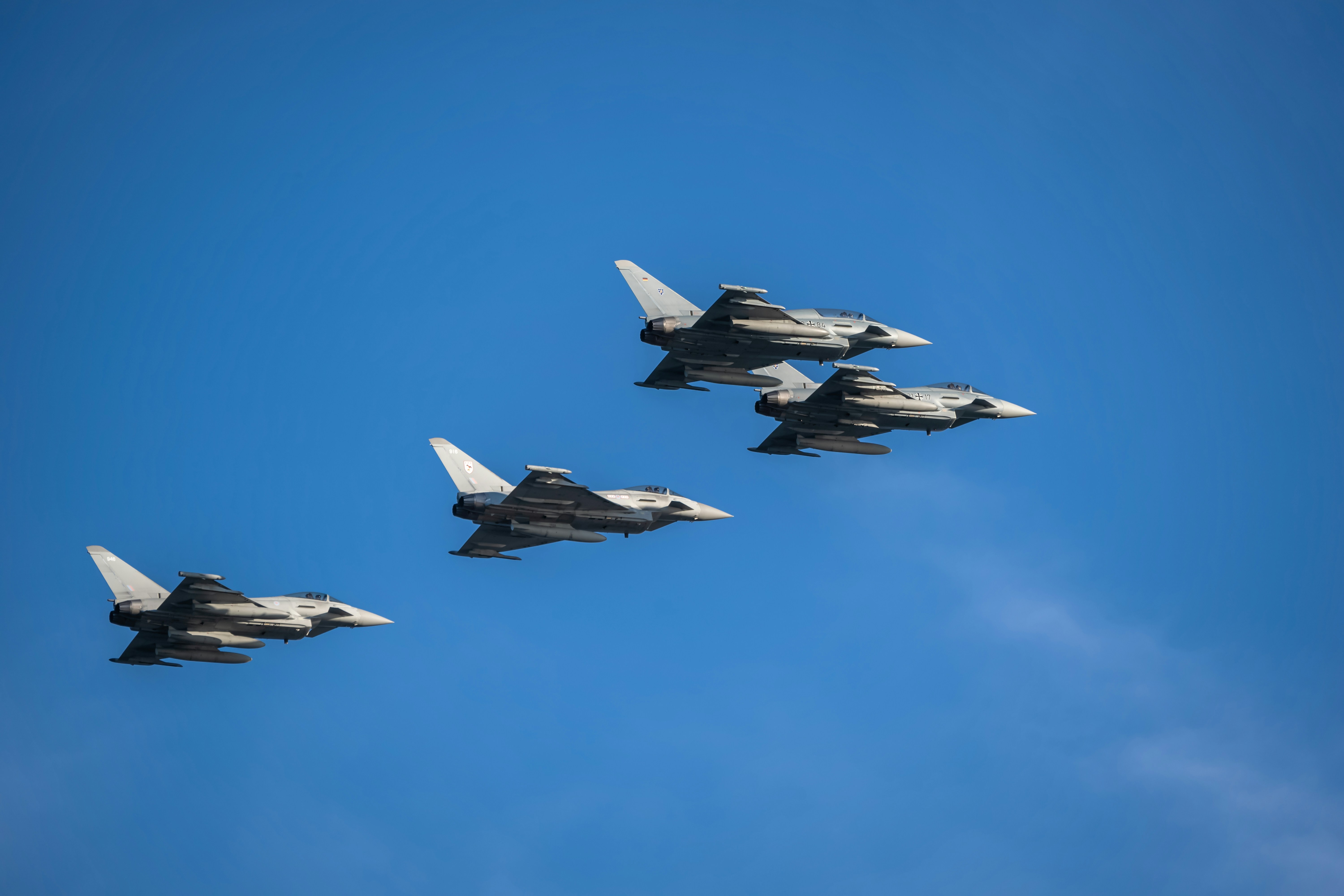
Modern defence increasingly depends on information advantage, resilient infrastructure and the ability to make decisions rapidly in complex operational environments. At the same time, potential adversaries are investing heavily in advanced digital technologies, including AI and quantum technologies.
Quantum computing and the wider family of quantum technologies offer the potential to enhance defence capability across planning, sensing, communications and navigation. While many applications remain under development, governments are already investing in research, experimentation and early adoption to understand how these technologies can be integrated into future defence systems. The UK Ministry of Defence has identified quantum computing, sensing, timing, imaging and communications as key areas for future capability development and is pursuing a strategy of becoming an informed early adopter.
- More efficient operational planning and logistics.
- Improved mission scheduling and resource allocation.
- Hybrid AI and quantum decision-support systems.
- Resilient navigation in GNSS-denied environments.
- Enhanced situational awareness through advanced sensing.
- Secure communications using quantum cryptographic techniques.
- Improved detection and imaging in challenging operational environments.
RESEARCH
Researchers worldwide are driving progress in this area with UK universities and industry playing an important role through the EPSRC-funded QCi3 Hub, QUSIT, QEPNT and IQN Hubs.