
CASE STUDYBuilding quantum networks
WhatARE QUANTUM NETWORKS?
A quantum network is a communications network that uses quantum physics principles to transmit, share and store information between different locations. Information is carried using light particles (photons) down standard optical fibre or wirelessly, in free space. Quantum information is encoded in quantum bits – or qubits – which unlike their classical equivalent are both a 0 and an 1, thanks to quantum superposition, namely the ability to exist in multiple different states or locations at the same time.
Quantum networks are designed to coexist with existing telecommunications infrastructure, while offering distinct advantages and additional functionality. Globally, there are many examples of real-world quantum network deployment, with China’s 12,000km terrestrial setup being one of the most advanced.
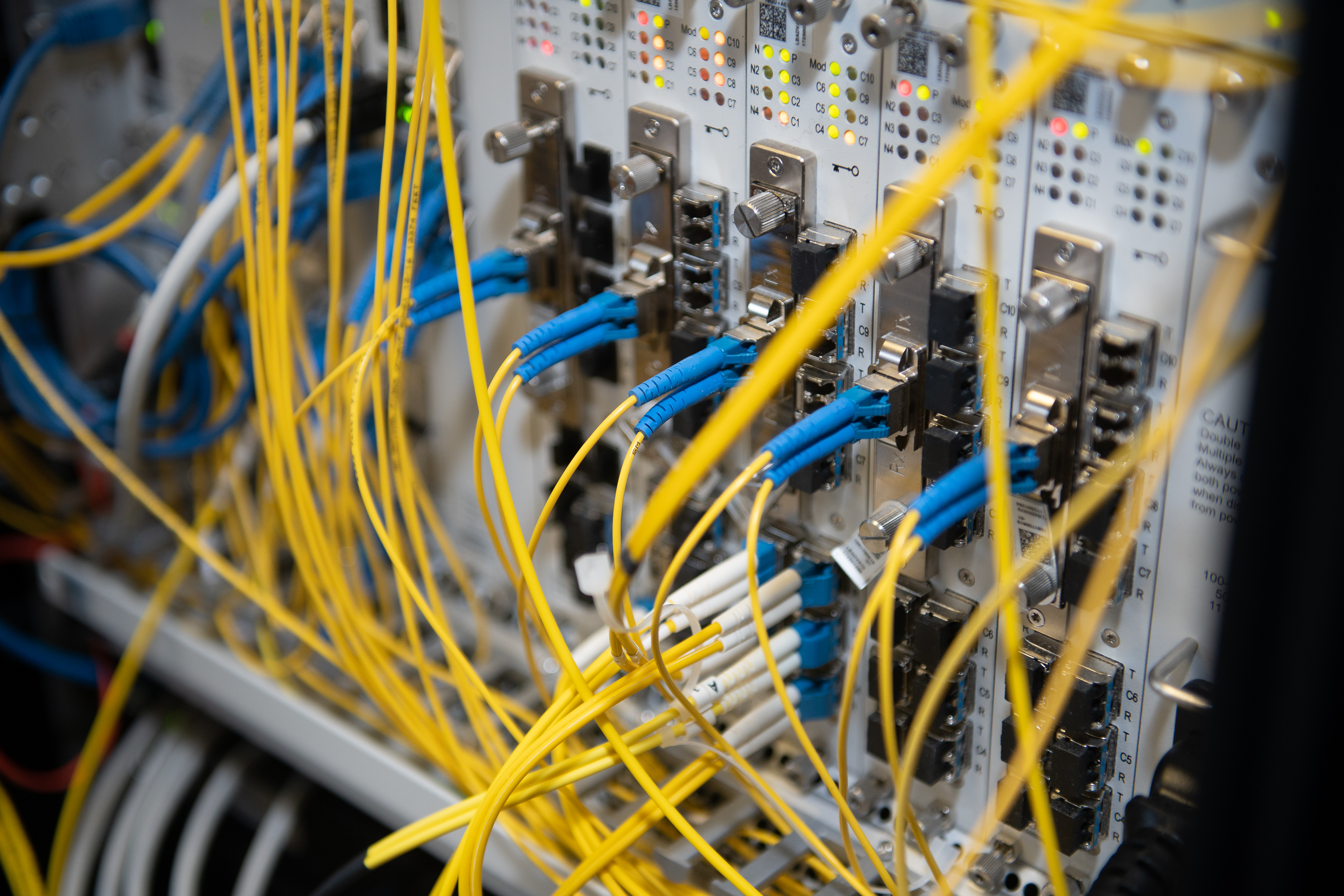
In the UK, researchers have established the UK Quantum Network (UKQN) spanning 410km of dark fibre and linking the metropolitan-scale quantum networks of Bristol and Cambridge via intermediate hops (or trusted nodes) at London, Reading, Froxfield and Bradley Stoke. Efforts are being made to expand this national network in scale and capabilities. A separate quantum network has been set up by BT and Toshiba, using standard-grade fibre across London to trial quantum-secure data services, in a world-first commercial example of a quantum network infrastructure.
Quantum communications offer distinct advantages in cybersecurity and as an infrastructure technology connecting other quantum devices, e.g. quantum computers or sensors.
Quantum networks are underpinned by these quantum principles:
- superposition (the ability to exist in more than one state simultaneously), which increases the volume of information that can be transmitted across a quantum network;
- entanglement (the unbreakable bond shared by two or more particles, even across huge distances), which enables the transfer of information via teleportation;
- the no-cloning theorem, dictating it impossible to copy unknown quantum states, and:
- quantum measurement and wave function collapse, dictating that any system in superposition is irrevocably disturbed upon being observed.
The last two properties, in particular, guarantee data security, even when adversaries use quantum technologies (e.g. quantum computers) to intercept quantum-secured information. The wave function collapse is the underlying principle behind the Quantum Key Distribution (QKD) security protocol used to transmit encryption keys. QKD can be employed in tandem with new, quantum-resistant algorithmic schemes (Post-Quantum Cryptography or PQC) to combat quantum computing decryption threats.
Furthermore, quantum networks with distributed entanglement offer connectivity advantages without classical equivalent. When connecting quantum computers or sensors with classically, the resulting network is powerful but reflects the sum of their individual capability. By contrast, when connecting devices using shared entangled states, the resulting quantum network becomes a supersystem where individual computational or sensing performance increases exponentially leading to unsurpassed processing power and unparalleled sensing precision.
One use of quantum networking is the secure distribution of encryption keys used in cryptographic systems. The exchange of these encryption keys is called Quantum Key Distribution (QKD) (you can learn more about QKD here). This application helps organisations secure sensitive data against current and future cyber threats, especially when used in parallel with advanced mathematical encryption, such as post-quantum cryptography. Initially, quantum networks are likely to be used in sectors where protecting information is particularly important, such as defence, government, healthcare, finance and critical national infrastructure.
In the longer term, quantum networks could support distributed quantum computing, where multiple quantum processors work together to solve complex problems. They could also enable networks of quantum sensors to work together in real time, sharing measurements to improve accuracy.
Cybersecurity threats continue to evolve, while advances in quantum computing could eventually compromise all currently used encryption methods. Developing quantum networks today helps organisations prepare for future risks. Governments and industry are investing heavily in quantum technologies, creating an opportunity to establish the infrastructure needed for a secure and globally connected quantum economy.
- Furure-proof data transactions
- Secure e-commerce, e-voting and digital identities
- Linking quantum computers across multiple locations
- Connecting quantum sensor networks for advanced sensitivity in e.g. environmental monitoring
- Protection of critical national infrastructure
RESEARCH
Researchers worldwide are driving progress in this area with UK universities and industry playing an important role through the EPSRC-funded IQN Hub.

The Face of Quantum Communications Technology
Learn more about the UK’s first Quantum Network